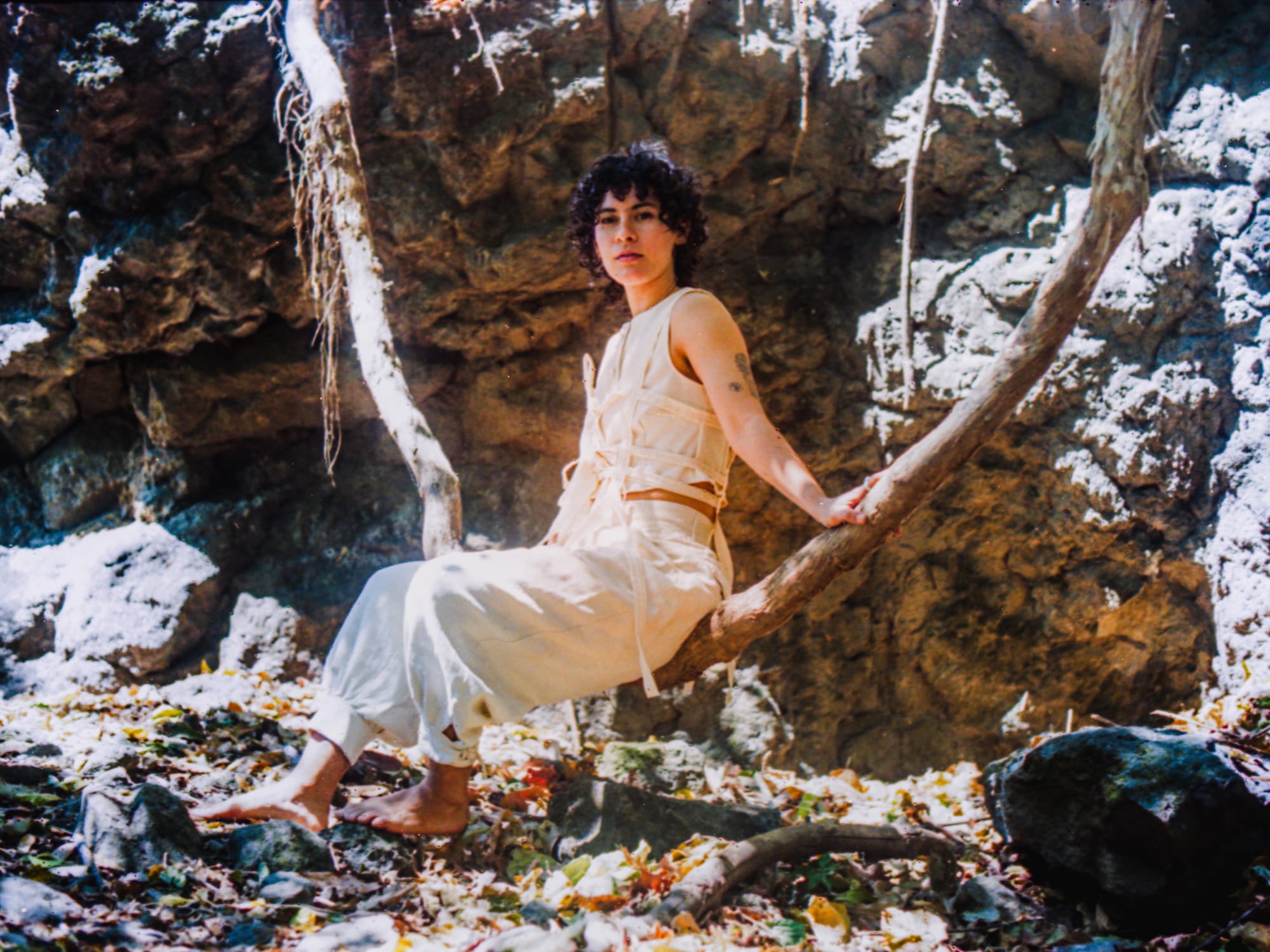
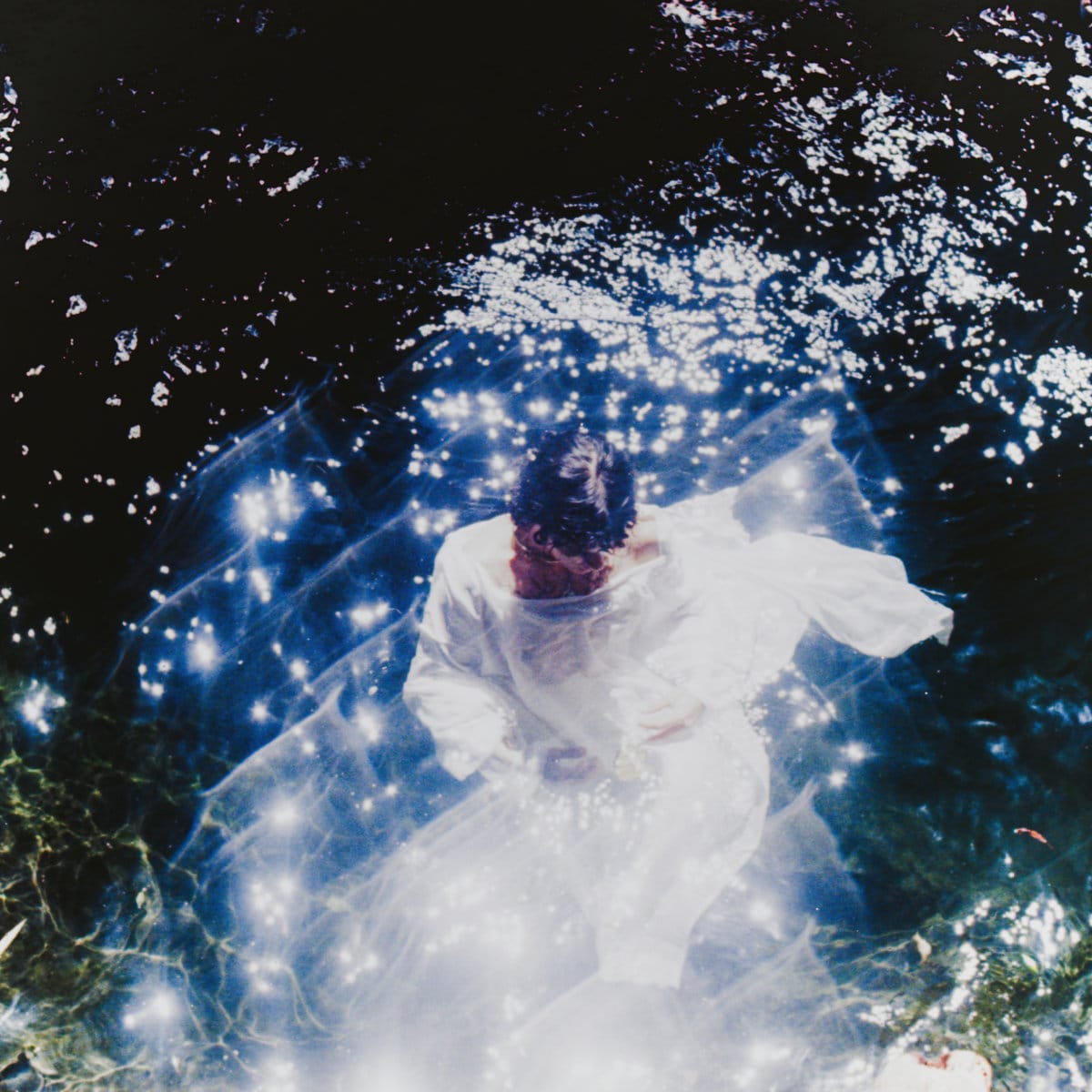
Brooklyn-based interdisciplinary artist iiisa (isabel crespo pardo) is one of the most captivating performers in the city. Their work spans powerfully ethereal vocal performances, tender mediations of collective memory by way of poetry, and a warming, ephemeral presence in any collaboration they touch. iiisa’s work considers Latin histories, queer thought, and an openness towards vulnerability. While they appear in many iterations–like poemsong trio sinonó, and avant-pop collective toso toso–iiisa is the apt improviser’s space to cultivate a solo electroacoustic practice. We recently sat down to discuss their upcoming release tanto te he querido, out October 2nd with Leaving Records.
isa crespo pardo (isa): I’m in the wilderness now. Well, I’m at Bard, which feels like the wilderness compared to New York City.
Yaz Lancaster (Yaz): You were just in rehearsal?
isa: Yeah. We’re working on this theater piece by Annie Dorsen. It’s really cool, but also really intense material.
Yaz: What’s the piece?
isa: It’s for 3 vocalists as actor-performers. It’s exploring the turn of the century from 1999 to 2000 and how it parallels so much of what’s happening now. It’s funny because we have different age ranges, so there’s certain things I just really don’t remember at all you know?
Yaz: That’s so cool. When is the performance happening?
isa: I think we’re doing a first showing in December, but the final iteration will be next year. There’s also some mini documentaries that go with it, so I think threading all that through takes a bit of time.
How are you doing?
Yaz: Good! I’m chilling for a bit now since I’m going on tour in Europe in a few weeks. I’m trying to take it easy until then.
I’m gonna jump in – I know you just said you have trouble remembering things – but can you try to remember your first experience with music?
isa: I’m not very good at firsts or any kind of superlatives, but I feel like a very early informative experience was singing with my family in a casual-after-dinner way. My parents are not musicians or artists by profession, but I find them to be extremely nuanced in their thinking, and quite critical and loving of art. We would sing different Latin American folk songs like boleros – songs in that canon. That was very formative for me.
Yaz: Totally. It’s so special to have grown up sharing music with your family in that way. Were you also studying music at all, or learning formally?
isa: Well, I always wanted to be a visual artist. I was more interested in that, and my parents had put me in piano lessons just as an activity to do, but not in a serious way. It wasn’t until high school when I moved to Costa Rica to attend a conservatory and had the intention of majoring in visual art, but they didn’t allow it. They were just like “It seems like you were in choir in school, do you want to sing?” And so I just said okay, I guess this is fun. It was this very haphazard way of getting into it.
Yaz: Wait, I actually had a similar kind of thing happen. When I was in middle school and they let us choose instruments to learn, I really wanted to play the cello – but I didn’t know what it was called. I asked for a violin, and they gave me this tiny instrument –
isa: Oh my god… (Laughing).
Yaz: Yeah. I was like, why is this thing so small? And why do I have to hold it differently? But I guess this is fine? And then I just stuck with it and didn’t really ask any questions.
isa: Did you ever go back to learn the cello? There’s still time.
Yaz: Nope! I don’t want to buy extra plane tickets either so I think I saved myself in hindsight (Laughing).
So you wanted to be a visual artist? What kind of art were you making?
isa: I wasn’t exposed to many kinds of visual art. I mostly enjoyed drawing. I also remember finding a bunch of clay near my house and making some sculptures, but in this intuitive child way where I just wanted to make things. I think about it being a kinesthetic activity. It’s something I often come back to – right now I’ve been studying metallurgy for a year and a half. I love the process of working with the material and understanding what it wants in a way. I feel like that’s similar to how I compose music as well: trying not to force anything to be what I want, but trying to listen a bit and go from there.
Yaz: That’s really sweet and I definitely get that from your music. So where in this was the point where you decided that you were going to be a musician?
isa: I’d done choir for fun in middle school, and at the conservatory, the only thing they offered in terms of lessons was art song. It didn’t really resonate with me and I was just doing it to do something. I also went to college in Costa Rica and started studying art song again just to do something with my time. But the whole time I was imagining if I kept doing music, What is the kind of music that I can do where I make my own things?
One of the many kinds of musics I grew up listening to was bebop. Like Charlie Parker and John Coltrane and Wes Montgomery. I felt like they had the tools to make their own things, and maybe if I studied jazz I’d be able to make my own thing. I was still quite unaware of the more experimental things that existed in the world because they weren’t in my orbit yet. I just googled like, Jazz School, and went to the first one that came up (Laughing). I didn’t apply for any other ones and somehow got in and it ended up being this bebop boot camp program, which was not necessarily what I was looking for, but another step on the way.
Yaz: Just want to pause for a second – Where were you before Costa Rica?
isa: In the Carolinas. We moved around every three years, and all the summer breaks that we could afford it, I would go to school in Costa Rica because they have a different school schedule. There was always this sensation that I’d eventually return to Costa Rica.
Yaz: Gotcha. So how did you move from the realm of art song, jazz and bebop into what you’re doing now? Or do you sort of consider it the same thing?
isa: I think jazz education is quite fraught. I still feel like there’s something that really draws me in about this incredible simultaneity of individual and collective expression that happens, and also this really interesting way of recomposing pieces. I think because I was in an environment where a lot of people were also unsatisfied with education and looking for other things, I ended up playing with a lot of people. I got exposed to a lot more music – and still feel that way today. There’s all these pockets of incredible things I’ve never heard of. It’s been a continual slope into new things.
And then I did a master’s in Contemporary Improvisation. I always just say I went through some periods of rigorous study and then some experimentation after, just trying to parse through what I learned. In the first period of study, it was more so about gaining a bunch of tools; and the second one was more of a question of If you’re an artist, what do you want to say or do, and for who and why? All of these more conceptual questions.
Yaz: Who or what were some of your biggest influences or areas of study when you were trying to figure all of this out?
isa: The first thing that comes to mind is peers. There’ll maybe be an external prompt for a gig you want to put together, and in the process of trying to, it’s like learning a new language when you’re trying to sound something out. Then you talk to other people and realize the way they do things is incredible.
I remember one of my friends asked me why I was writing in English when my first language was Spanish. I was so struck by the question because it poked at this feeling I had. I grew up singing all of these songs that are so poetic and beautiful that I didn’t think I could write because I didn’t think I could feel comfortable sitting beside something that I admired so much. But talking to this friend I realized that’s bullshit. So I tried. It’s just music at the end of the day.
In terms of my listening, I’m quite like a grazer. I get struck by the first minute of something – or an album that I remember what the cover looks like.
Yaz: That really resonates with me. I also listen to a million things all the time. When I was studying violin in school, I had all these composer friends that were making their own things. For some reason, it had never occurred to me before that that was a possibility – That I could make my own thing. I obviously started to write and compose after realizing that. But having conversations and dialogue with people around you in your communities is such a formative experience for a lot of people.
isa: Peers were and still are so important to me. I love a debrief after a show. Sometime last year I had a group of friends where if someone was trying out new material, we’d all go over and give each other feedback. It’s such a generous act to give thoughtful critique on something.
Yaz: Yeah, there needs to be more spaces for sharing in-progress work, and even just sharing things that you’re listening to and learning about, and having dialogue around these things. It doesn’t have to happen in educational settings – in fact it’s probably best if these are happening in more low-stakes communal and shared spaces.
isa: When I lived in places less hectic than New York, I used to host these gatherings where somebody would either show something, or we would try prompts out together for fun.
Yaz: We need to be playing and jamming together more!
I’m going to jump to the album – I listened to it three times yesterday. It’s so gorgeous. Can you tell me about it? What’s at the root of it? Why did you make it?
isa: I made this album for the people that I keep the closest, and the people who have made me who I am. One of the things at the core of it is trying to break the myth of the individual. I think of it more as a constellation of shifting presences, and think of time as something nonlinear or flat like a prism. There are conversations constantly moving in every direction.
I’ve been collecting recordings from different moments with my family in the way in which you take photographs. I had all of these recordings that I wasn’t necessarily doing anything with. I don’t remember exactly why, but I started to re-listen to them – and I have about 10 years worth of these. I was so struck by the immediacy of hearing a moment and being transported to an experience that could never happen again for obvious reasons, but also maybe for reasons of someone passing on, or different ruptures. That in combination with my own fascination with transformation and possibility to change gave birth to this album.
I feel like there’s a really intimate collection of questions that are being posed, and not necessarily by me. They ping-pong back and forth: I feel them coming at me at times, and sometimes from me to someone else. It was a lot of listening to the archive to see the ways in which memories and conversations could either become parallel to these questions, or offer a different perspective on something I was thinking about. There’s a nonlinear becoming in cycles – there’s a lot of darkness within it, but there’s also a sentiment of starting over that I hope people who listen can insert themselves into. It’s okay to fail and start again, and in that failure there’s so much to be learned as well.
Yaz: It’s such a vulnerable record. Especially because it’s a solo project. It’s already vulnerable in that way, but also being songs and vocals-forward, and then of course with field recordings we get this secondhand sense of intimacy. It’s not necessarily our archive that’s being tapped into, but because it is an archive, it has that relation to memories that we–the listeners–enter that intimate space that you are creating. It’s really beautiful.
I’m wondering if you can get into more of the actual process of making it?
isa: The process was intense, but also really fun. I rewrote and re-produced the songs on the record many times. There’s one track that I had already recorded a couple of times. Then I was on tour with a friend in Mexico, and I listened to it and it was all wrong. I went into an empty room at the place we were staying and re-recorded the vocals on my phone and then produced the track around that.
Then it was deciding the flow. The whole time I was trying to keep in mind that I wanted to make one single gesture that could loop. Like, What would it feel like to go from the end to the beginning? I was concerned about the experience of the line between everything. So it was a lot of composting of a previous version and trying again. The single is maybe the track that was recomposed the most. It felt fun to trust the material enough that I could make big changes.
Yaz: Was that the most challenging thing about working on it?
isa: I feel like that part wasn’t challenging – mostly quite fun. I think the challenging part was at the beginning where I had resisted working in a solo capacity for a really long time. I love collaborating with people, and it’s so scary to be alone. I realized when I started writing that so much of writing for an ensemble is not only the composition, but also writing in a way that I’m taking care of the experience for other performers. When I came to writing solo, I realized that there had been a kind of disconnection between what I feel like is a more surface level self that’s interacting and doing quotidian things, and then the deeper self that is really tapped into something else. I had to first rebuild that connection before I could write anything. It was like, When I’m alone, what do I want to write? Why? What do I want to feel like when I’m performing? Those are intimate questions that I wasn’t so aware of the answer before I started working solo.
Yaz: You collaborate with so many people, and have a lot of really wonderful collaborative projects. What’s your process then, when you’re working with collaborators? Is it different with each group of people?
isa: Yeah, each project has its own flavor. I don’t feel a lot of difference between composition and improvisation. It’s more so about the timing or setting in which it happens. In all of the projects, there’s always some combination of material that we decide, and then we decide how to play with it. Each project has its own set of aesthetic concerns and then different skills at which change can happen. It’s also so much of – a lá Duke Ellington – the people you collaborate with are also the piece.
Yaz: Is there anything else important about tanto te he querido that we should know?
isa: There is a big difference to me between an album and a performance. The album to me feels like something between a photograph of a moment and a sculpture. The performance of that material is very, very different from what is on the record, to the point where I listened to the single when it just came out and was like, Oh wow. I feel some difference between the live performance and that recording. So I’m excited for people to hear it, but also to tour it.
Yaz: I’m excited to see the live performance too! I feel like you perform so much and are constantly traveling or on tour too.
isa: Really? Wow, social media will have you believe anything (Laughing).
Yaz: No, wait (Laughing)! I feel like you’re one of the people, along with Mari Rubio (more eaze)–who I just spoke to as well–that I always see show flyers for and can never catch you because I have something at the same exact time.
On that subject, do you have any thoughts about the current state of live music and performing?
isa: I feel a lot of love for any initiative that is run by people that are actually involved in a community and actually have experience with that community. Pay me, but DIY for life. What are your thoughts?
Yaz: I’ve been talking about it with a lot of people. Touring is so impossible unless you have some external reason to be going somewhere. For me, I’ve toured or played out of NYC a couple of times, and they’ve all been these small, completely DIY operations set up by myself and homies I have in these other places. I don’t drive, so that’s already a huge disadvantage for me in terms of touring the US. The main way I’m able to tour is when I get a commission that supports me coming out for the premiere, or one well-paid gig, and then set up shows around that thing. I don’t understand how anyone in the US is able to go on tour without being signed to a larger label, or having money to front all of the costs. Or you just accept that you are making absolutely no money and sleeping on floors for however long you’re going for. It’s ridiculous.
isa: I feel like working solo is wanting a little more flexibility, and because it’s more affordable. The dream is to bring all your pals everywhere and go together. But it’s expensive.
Yaz: But hopefully it’ll break open at some point. I feel like we’re getting there soon. People are going to realize that we actually have to materially support the artists and shows we like going to. That’s always the dream though, to travel with your friends and collaborators. What else are you dreaming about?
isa: I don’t know exactly what, but I feel like there's a lot of different visual art and poetry threads that I’m currently following. I’m open to where they’ll lead – I don’t want to force anything. I’m extremely engrossed in metalworking right now, and poetry forever and ever. Textile work is also really interesting to me. I’m just trying to make shit all the time to be honest. That’s my true dream.
iiisa’s tanto te he querido is out everywhere on October 2, 2026 with Leaving Records. Keep up with their website or instagram for tour updates.
Related listening:
- Kalia Vandever – Mana
- Chris Ryan Williams – Odu: Vibration II
- toso toso – toso toso

